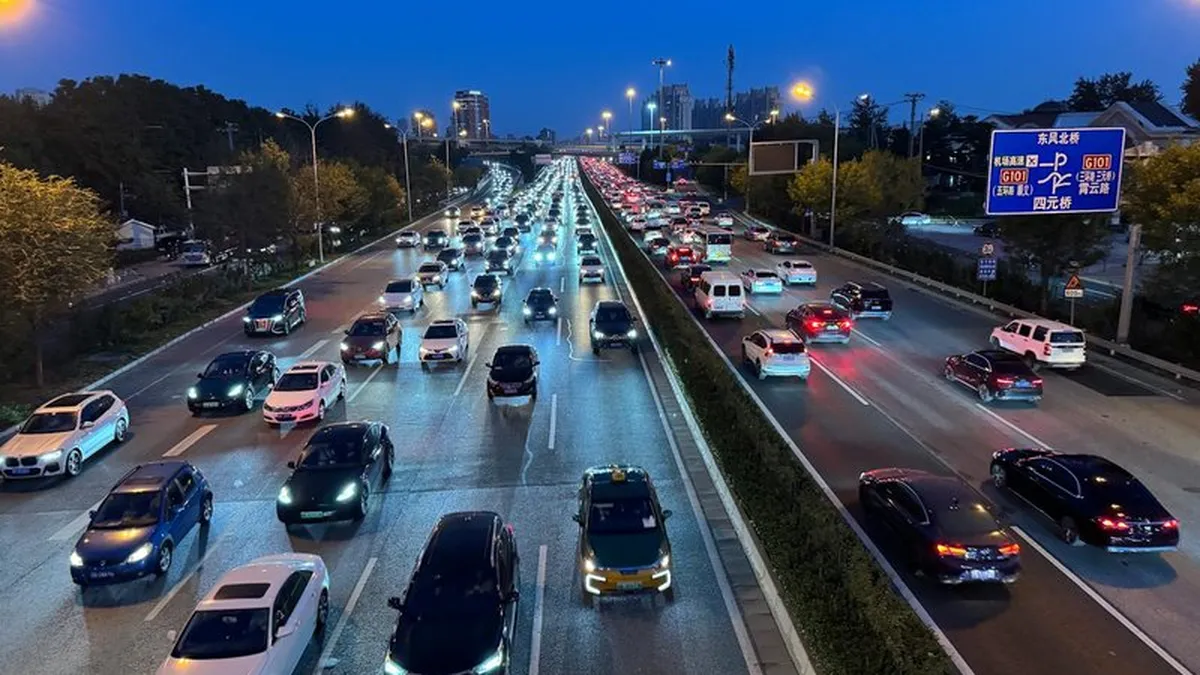
South Korea Eyes Driving Bans as Oil Crisis Deepens
Seoul prepares nationwide fuel restrictions as crude prices threaten economic stability amid Middle East conflict
SEOUL — The last time South Korea rationed fuel for ordinary drivers, disco was king and the Berlin Wall still stood.
Now, as oil prices shatter post-pandemic records, Seoul is dusting off those 1970s playbooks. Finance Minister Koo Yun-cheol's weekend announcement that nationwide driving restrictions could hit civilian vehicles represents more than energy policy — it's Asia's first acknowledgment that the Iran-Israel war has crossed into economic warfare.
What's happening
• Oil prices surge past $110/barrel, highest since 2022
• Seoul considers civilian driving bans if crude hits $120-130
• Government already restricting official vehicle use
Why it matters
• Asia's fourth-largest economy signaling systemic stress
• Regional energy security reaching breaking point
• Consumer behavior about to change fundamentally
⬇ Full breakdown below
Background
South Korea imports 95% of its energy needs, making it one of the world's most vulnerable major economies to oil shocks. The country burned through this lesson during the 1979 crisis, when gas lines stretched for blocks and the government imposed alternate-day driving based on license plate numbers.
But this isn't 1979.
"We're looking at supply disruption combined with demand destruction," says Kim Jae-sung, energy analyst at Seoul National University. "The government knows rationing civilian vehicles crosses a red line — they wouldn't float this unless the math is terrifying."
What Happened
The trigger wasn't just oil prices breaking $110. It was the speed.
Crude has jumped 35% in three weeks as Iran's threats to close the Strait of Hormuz — through which 20% of global oil flows — moved from bluster to operational planning. South Korean refiners, already squeezed by sanctions on Russian crude, are facing their worst supply crunch since the Gulf War.
Here's what most people are missing: Seoul's driving restriction trial balloon isn't about short-term price spikes. It's about preparing for sustained $150+ oil in a world where alternative supply routes don't exist at scale.
The government has already banned non-essential official vehicle use and is pushing telecommuting mandates for public employees. Private sector giants like Samsung and LG are following suit, signaling coordination between Seoul and its industrial champions.
Regional Implications
South Korea's move is being watched across energy-importing Asia with the intensity usually reserved for currency interventions.
Japan, Thailand, and the Philippines — all heavy oil importers — are running similar calculations. If Seoul, with its advanced refining capacity and strategic petroleum reserves, is considering rationing, smaller economies face existential pressure.
"This is the canary in the coal mine for the entire region," warns Dr. Sarah Chen, energy security specialist at the Institute for Strategic Studies in Singapore. "When Korea talks rationing, you know the regional energy architecture is breaking down."
And this is where it gets dangerous: Asian economies built their growth models on cheap, reliable energy flows. That assumption just died.
What Comes Next
The $120-130 oil price threshold Koo mentioned isn't arbitrary — it's where South Korea's current account turns deeply negative and inflation becomes politically unmanageable.
Markets are already pricing in that scenario. Seoul's won has weakened 8% against the dollar this month, and consumer confidence just posted its steepest drop since COVID-19's initial wave.
But here's the catch: driving restrictions might not even work.
Modern South Korea runs on just-in-time logistics networks that assume constant vehicle mobility. Limiting civilian driving could trigger supply chain breakdowns that offset any fuel savings — creating the economic disruption Seoul is trying to avoid.
The real test comes in April, when seasonal demand typically peaks and Iran's threatened Hormuz closure could become operational reality.
What happens then may define whether Asia's energy-dependent economies can survive in a world where oil flows have become weapons of war.

Discussion