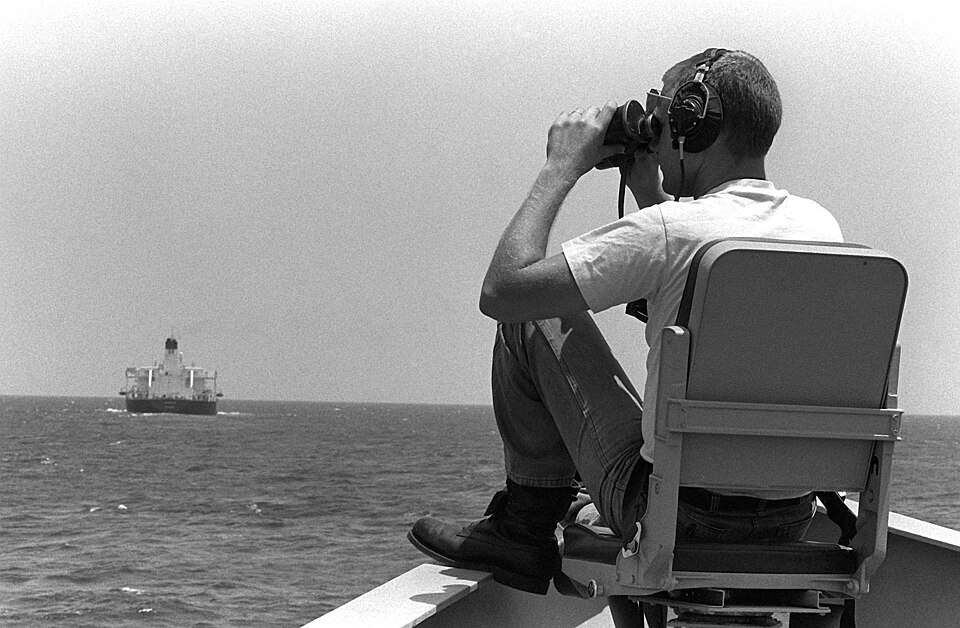
Iraqi oil tankers drift in Gulf as captains fear war
Crews wait hours for naval clearance while Brent swings $15 daily. Insurance rates triple as 20-year buyer relationships collapse.
BASRA — The captain cut his engines at dawn and let the *Al-Furat* drift. For three hours, the 280-meter tanker carrying 2 million barrels of Iraqi crude sat motionless in the Gulf, waiting for word from shore.
Word never came.
"We don't know if the Americans will board us, if the Iranians will escort us, or if someone will just sink us," said Captain Hakim al-Zubaidi, lighting his fourth cigarette before 9 AM. "So we wait."
This is what the oil trade looks like now. Not the smooth logistics chains that kept global markets humming for decades. Chaos. Captains making life-or-death calls with incomplete information while Brent crude swings $15 a day.
The *Al-Furat* finally got clearance Thursday afternoon — from three different navies. The Iraqis said proceed to Basra. The Americans said maintain course but prepare for inspection. The Iranians said nothing, which in these waters counts as permission.
Al-Zubaidi chose the Americans. Lesser of evils.
Iraq caught between superpowers
Iraq exports 3.3 million barrels daily through the Gulf. Every drop passes through waters where US and Iranian forces track each other with targeting radars. Every tanker captain becomes a diplomat.
"Before the war, this was routine," said Mahmoud Hassan, Iraq's deputy oil minister, reached by satellite phone from Baghdad. "Load cargo, transit Gulf, deliver oil. Now each voyage is a negotiation."
Iraq needs both powers. The US buys 400,000 barrels daily of Iraqi crude. Iran provides electricity for Baghdad's grid and security for Iraq's Shia shrines. When Washington and Tehran fight, Iraq bleeds revenue.
The numbers tell the story. Iraqi oil exports fell 18% since Iran's Supreme Leader Ali Khamenei was killed in February. Not because of sanctions. Because of fear.
"Insurance rates tripled overnight," said Ali Shallal, who runs Iraq's state oil marketing company. "Some European buyers just stopped calling."
What captains see out there
Al-Zubaidi has run this route for 12 years. He knows every reef, every patrol pattern, every radio frequency. What he doesn't know is which flag to trust.
Thursday's transit took 14 hours instead of the usual eight. The *Al-Furat* was stopped twice — once by USS *Porter* for a "routine inspection" that lasted three hours, once by Iranian speedboats that demanded to see manifest papers.
Both navies were polite. Both were armed.
"The Americans board with clipboards and cameras," al-Zubaidi said. "Very professional. The Iranians board with Kalashnikovs and attitude. Also professional, different style."
His crew of 23 includes Iraqis, Filipinos, and two Pakistanis. None signed up for combat pay. All are getting it now — an extra $2,000 monthly hazard bonus that Iraq's oil ministry approved in March.
The Pakistanis want off at the next port. Can't blame them.
Fear costs money
Every delayed tanker costs Iraq $80,000 in demurrage fees. Every cancelled cargo costs $180 million in lost revenue. The math adds up fast.
"We're hemorrhaging money," Hassan acknowledged. "But what's the alternative? Stop exporting? That kills our economy in two weeks."
Iraq's 2026 budget assumes $85-per-barrel Brent crude and 3.5 million barrels daily in exports. Current reality: $91 crude but only 2.7 million barrels reaching market. The revenue roughly balances, but the volumes don't.
Refiners in India and China still buy Iraqi crude — at $4-per-barrel discounts to account for "transit risk." European buyers demand $8 discounts. Some just walked away.
"Eni cancelled their March contract," said one Iraqi oil official who requested anonymity. "Total reduced their April order by 40%. These are 20-year relationships ending over a war that isn't even ours."
The captain's choice
Al-Zubaidi earns $8,500 monthly, good money in Iraq. His wife wants him to quit. His two sons, both studying engineering in Baghdad, need the income.
So he keeps sailing.
"Every voyage, I think this might be the one," he said, watching Iranian patrol boats shadow his starboard side. "The one where someone makes a mistake, where the radios fail, where politics becomes bullets."
But the *Al-Furat* needs fuel. Iraq needs revenue. The world needs oil.
The captain stubbed out his cigarette and ordered ahead slow. Destination: Basra terminal. ETA: tomorrow morning, assuming nobody shoots first.
His next cargo loads Monday — 2.1 million barrels bound for Rotterdam. The Dutch buyer wants a $6 discount for war risk.
Al-Zubaidi will take it. In this business, any deal that gets you home is a good deal.

Discussion