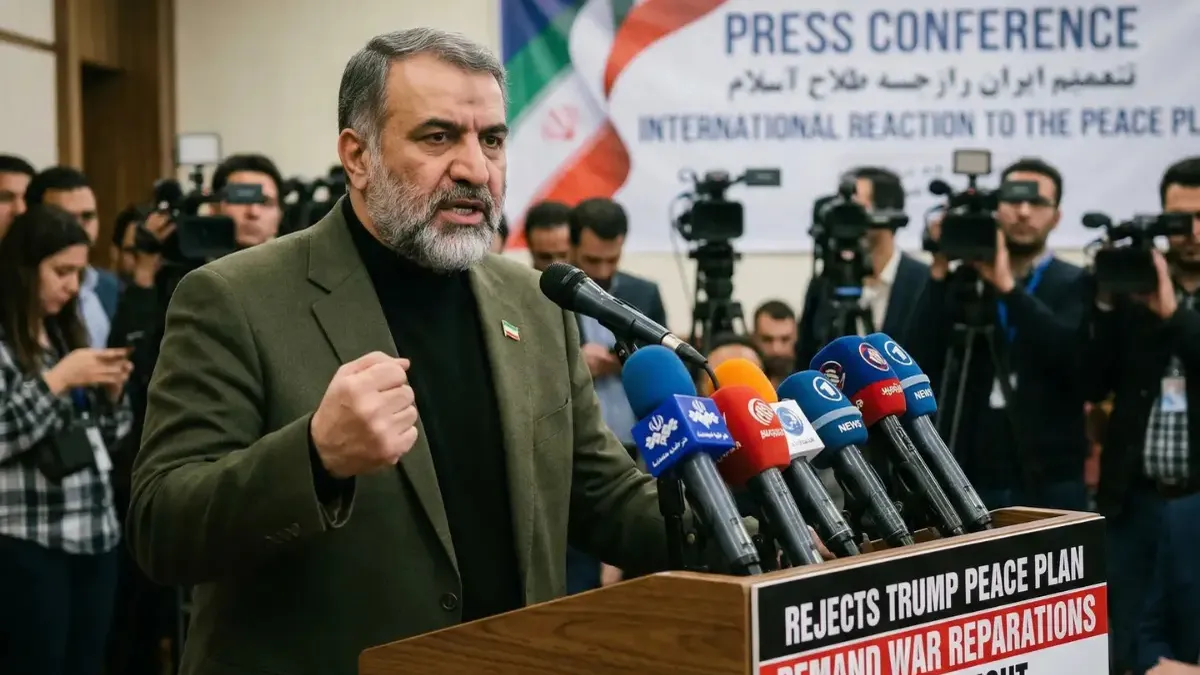
Iran Demands War Reparations in Trump Peace Plan Rebuke
Tehran's counterproposal seeks Strait of Hormuz control as nuclear diplomacy stalls
WASHINGTON — Iran has categorically rejected President Trump's ambitious 15-point peace plan, countering with demands that would fundamentally reshape Middle Eastern power dynamics and challenge decades of American strategic doctrine.
Tehran's counterproposal, delivered through Swiss diplomatic channels Tuesday, calls for $200 billion in war reparations dating to the 1980-1988 Iran-Iraq conflict and Iranian maritime control over the Strait of Hormuz, through which one-fifth of global oil passes daily.
What Happened
The Iranian response represents a stark rejection of Trump's framework, which intelligence sources indicate included sanctions relief tied to nuclear facility inspections, regional military restraint commitments, and prisoner exchanges. Instead, Tehran's demands would reverse core elements of American Persian Gulf strategy established since the Carter Doctrine.
"This is Iran's maximalist position designed to test Trump's appetite for genuine compromise," said Dr. Farideh Farhi, Middle East specialist at the University of Hawaii. "They're essentially asking Washington to pay for decades of containment policy."
The Strait of Hormuz demand proves particularly provocative. Iranian control would theoretically allow Tehran to throttle global energy supplies, giving the Islamic Republic unprecedented economic leverage over Western economies still recovering from recent energy crises.
Regional Implications
The proposal has already triggered alarm among Gulf Arab states, who view Iranian Hormuz control as an existential threat to their oil-dependent economies. Saudi Arabia and the UAE have quietly signaled to Washington their opposition to any arrangement ceding maritime authority to Tehran.
"Iran is essentially asking for a regional hegemony deal disguised as peace negotiations," observed Michael Stephens, associate fellow at the Royal United Services Institute. "No American administration could accept these terms without abandoning core allies."
The reparations demand specifically targets American military support provided to Iraq during the brutal eight-year war, including intelligence sharing and naval escorts for Kuwaiti tankers during the 1987-1988 "Tanker War."
What Comes Next
Trump administration officials have not publicly responded to the Iranian counterproposal, though private diplomatic channels remain active. The rejection complicates Trump's campaign promise to resolve the nuclear crisis through direct negotiation rather than military action.
Iranian Supreme Leader Ali Khamenei's recent statements suggest Tehran believes time favors their position, particularly as China and Russia expand economic cooperation despite sanctions. Iran's enriched uranium stockpiles have grown substantially since Trump's 2018 nuclear deal withdrawal.
The stalemate effectively returns US-Iran relations to their pre-negotiation status, with both sides maintaining irreconcilable positions. Congressional hawks are likely to interpret Iran's demands as evidence that diplomatic engagement remains futile.
European allies, who had hoped Trump's peace initiative might succeed where previous efforts failed, now face renewed pressure to choose between American sanctions enforcement and their own economic interests in Iranian energy markets.
Readers seeking background on previous US-Iran diplomatic initiatives may find value in examining the Obama administration's Joint Comprehensive Plan of Action negotiations.


Discussion